
In the latest AI4ST Practice Lab session, participants moved from theory into the messy, productive reality of everyday work.
Building on workflows mapped in the previous session, the group explored where AI capabilities might realistically support sustainability transformations practice, and what could be lost in the process. The workflows included remote sensing and climate modelling, qualitative data analysis, literature reviews, coding, and other forms of knowledge work.
At the centre of the session was a deceptively simple question: where could AI help, and at what cost?
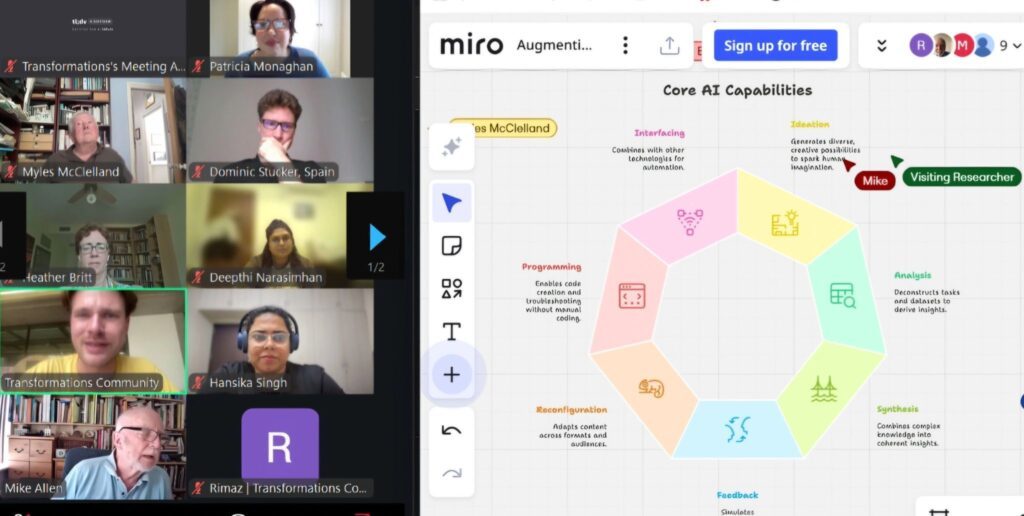
The group worked with two frameworks. The first mapped core AI capabilities, including ideation, analysis, synthesis, feedback, reconfiguring content, programming, and interfacing with other tools. The second helped participants examine risks and tensions that may arise when those capabilities enter real workflows, including hallucination, bias, collapsed nuance, stylistic monoculture, and the erosion of skills we may not immediately realise we are losing.
Several tensions stood out:
AI capability is not AI suitability. For almost every workflow step we examined, there was a plausible AI application. But our discussions continually affirmed and deepened a shared sense that just because AI tools possess capabilities that could be applied to our work, it doesn’t mean they should. Break out room discussions were focused on weighing up the advantages of using AI against the various risks and tensions its use would pose, as well as against the value of humans doing the work themselves. Our human efforts and contributions — emotional, messy, relational — are often where the transformative parts of work emerge from. Concerns were raised that systems change depends on presence, on reading rooms, on the slow and sometimes uncomfortable process of building trust. Mapping systems change into workflow steps is useful, but it shouldn’t flatten what actually matters about the work.
Cognitive atrophy or cognitive enhancement? Ollie summarised emerging evidence which suggests that in many cases people who use AI to support their analytical or creative work often feel that they have learned or achieved something more by using AI , when in reality they actually retain or produce less than they would have without it. less. A major concern, then, is not only skill atrophy over time, but that we may not even notice it happening.
Joy, struggle, and the non-instrumental value of work. Perhaps the richest moment of the session came from one participant reflecting on a week she had spent heavily delegating her scientific coding to AI. When she stepped back and worked through the model herself, she had a breakthrough, something the AI had not flagged, something that came from embodied, unhurried attention to her own data. Her colleagues noticed her energy shift. That kind of moment, she observed, is not simply a productivity input. It is part of what makes the work not just worth doing, but genuinely joyful. Automating it away is a loss.
A question we did not fully answer
We ran short of time before reaching what may be the most important layer of the framework: not just identifying where AI capabilities apply and where tensions arise, but asking what we would need to do to responsibly manage those tensions — and whether, on reflection, some augmentations are simply not worth pursuing.
That is exactly where we pick up next time.
In the next session
On 14 July, we will move from mapping to judgment. Participants will reflect on what it would realistically take to implement an AI-augmented workflow: what organisational trust or buy-in is required, what safeguards are necessary, and how these choices sit ethically and politically. We will also ask a harder question about the kind of practitioners we want to become,and the role of wisdom in our choices: whether some potential uses of AI may appear beneficial and even responsible, but are ultimately ‘unwise’. but
If you committed to a small experiment after the last session, please bring it. If you have a workflow tension you are still sitting with, bring that too!
The session will also ask a deeper question: what kind of practitioners do we want to become, and what role should wisdom play in our choices about AI?